Finding Meaning in the Time of AI: A Search Strategy Showdown
Feb 6, 2026

Have you ever known the exact answer to a question exists in a database, but you simply couldn't find the "magic words" to surface it? Traditional search engines can sometimes feel like strict librarians. If you don't use their exact terminology, they might not find what you're looking for.
In the time of AI, I've been fascinated by how this gap is closing. To learn more about it, I spent some time building a project to explore how different search strategies actually perform when put side-by-side. I wanted to share some of what I discovered about the balance between matching words and understanding meaning.
The Three Ways We "Find" Things
1. Lexical Search (The "Strict Librarian")
Imagine asking for a book on "Cats." A Lexical system looks specifically for that word. If the perfect book is titled "Felines," it might be overlooked simply because the characters don't match.
- How it works: It looks for exact word or character overlaps.
- The Strength: It is incredibly reliable for finding specific IDs, technical codes, or unique names.
2. Semantic Search (The "Intuitive Friend")
You tell a friend, "I need something to move faster on two wheels." They immediately suggest a "Bicycle." You never said the word "bicycle," but they understood your intent.
Semantic search doesn't just look at characters; it looks at intent.
- How it works: It uses mathematical patterns to identify similar concepts, even if the vocabulary is completely different.
- The Strength: It excels at natural language and synonyms.
3. Hybrid Search (The "Best of Both Worlds")
This approach tries to capture the best of both by running Lexical and Semantic engines at the same time. It then merges the results into a single list using a method called Reciprocal Rank Fusion (RRF).
The Logic of Tweakable Weights
One interesting thing I found is that Hybrid search isn't "one size fits all." You can apply weightages to decide which "expert" to trust more for a specific task. Think of it like a slider:
- Slide toward Lexical: If you're building a tool for engineers who search for exact error codes, you might give the "Librarian" more weight to ensure those exact matches stay at the top.
- Slide toward Semantic: If the tool is for general questions, you might give more weight to the "Friend" so the system focuses on being helpful rather than literal.
The "Login Blocked" Case Study
To see this in action, I ran a test query for "login blocked". D1, D2, and D3 refer to the Document IDs of the articles being searched.
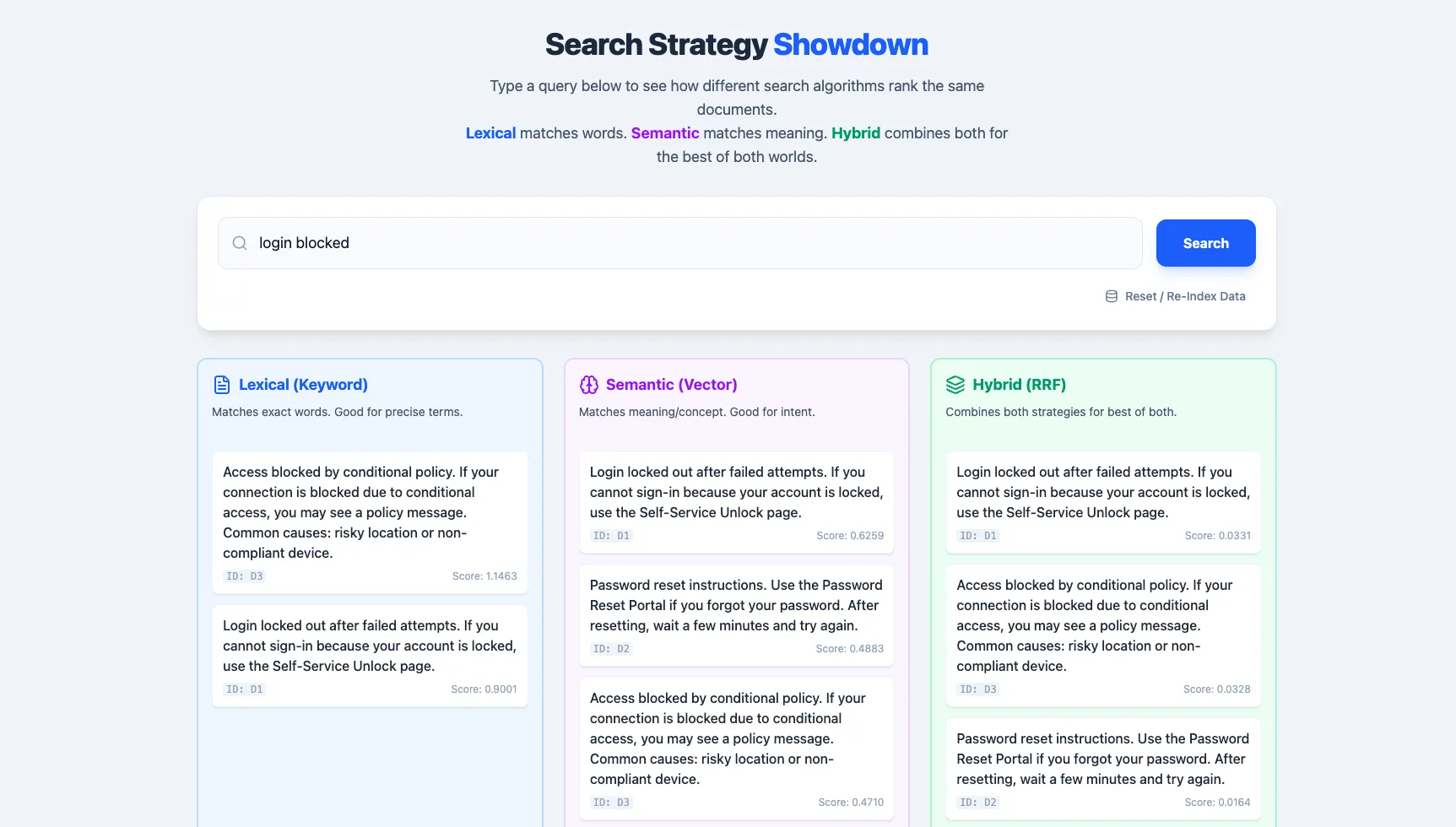
- The Lexical Gap: The Lexical engine easily found D3 (contains "blocked") and D1 (contains "login"). However, it missed D2 ("Password reset instructions") entirely because those specific words weren't in the text.
- The Semantic Advantage: The Semantic engine recognized that a password reset is a relevant solution for a "blocked" user, so it ranked D2 as the second-best result.
- The Hybrid Balance: When the results were merged, the ranking shifted. In the Semantic-only view, the order was D1 → D2 → D3. But in the Hybrid view, the order became D1 → D3 → D2. Because the Lexical engine gave D3 a very strong "vote," it pushed that exact match back into the #2 spot.
Check out the project
If you want to see how these rankings are calculated or try the implementation yourself, I've open-sourced the code here:
👉 https://github.com/asircar/ai-search
This project was a personal deep dive into the 'why' behind our search experiences. It's been a great reminder that while AI is changing the tools we use, the goal remains the same: helping people find exactly what they need, exactly when they need it. I'd love to hear how you're seeing these search shifts in your own work.
#AI #HybridSearch #TechExploration #Search