Beyond the Pulley: Upgrading the Scaffolding of the New SDLC
Jun 2, 2026
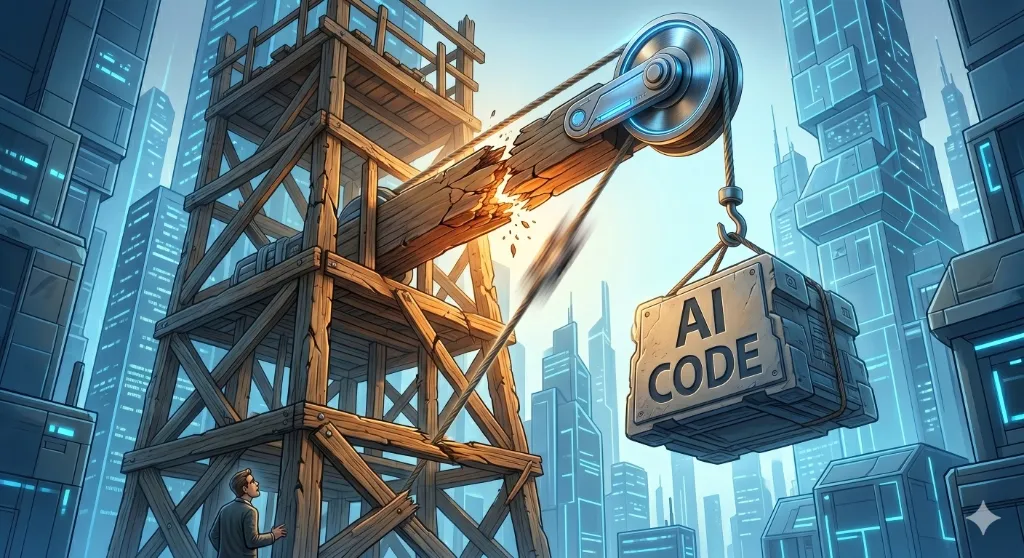
In my last article, I talked about the profound mindset shift we are facing in engineering leadership—the transition from the Human Chain (where velocity is limited by manual, bucket-by-bucket handoffs) to the Pulley Operator (where AI gives a single engineer the leverage to lift massive cognitive loads).
But as we deploy these tools at scale, a jarring paradox has emerged in engineering telemetry.
Data across thousands of developers shows an incredible surge in individual output—tasks completed are up roughly 21%, and pull requests merged have spiked by nearly 98%. Yet, overall delivery remains flat or, worse, less stable. PR review times are stretching, change-failure rates are climbing, and production incidents are rising.
In the industry, they are calling this "Acceleration Whiplash."
The diagnosis is clear: If you hook a high-speed mechanical pulley to an old wooden scaffolding designed for a human chain, the entire structure will collapse.
Google’s 2025 DORA report hit the nail on the head: AI’s true value cannot be unlocked by simply giving developers a shiny new tool. It requires reimagining the entire system of work it inhabits. If we don’t upgrade our processes to match the new physics of software creation, we don’t get efficiency—we just accelerate the accumulation of technical debt.
Here is the operational blueprint for re-engineering your SDLC to survive and thrive in the AI era.
1. Product Management: From "Vibe Coding" to Spec-Driven Contracts
As Andrej Karpathy recently highlighted, the industry is rapidly shifting away from "vibe coding"—where developers loosely prompt an AI until it works—toward rigorous, agentic engineering. In this new paradigm, a traditional, text-heavy Product Requirement Document (PRD) is no longer sufficient. If you feed ambiguous text into an AI context window, you get AI-accelerated garbage out.
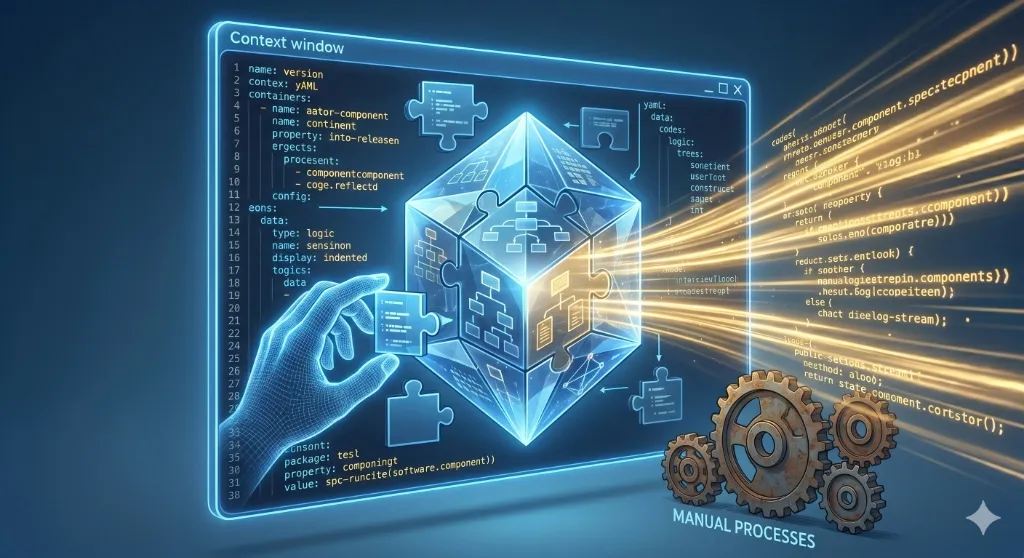
- The Actionable Shift: Transition your PMs toward Spec-Driven Development. Adopt frameworks similar to GitHub’s Spec Kit, treating the product specification as an immutable contract. Mandate that PMs write machine-readable, hyper-precise Markdown or YAML blocks detailing explicit business logic, strict data schemas, and edge-case definitions.
- Why it works: When engineers feed structured, deterministic specs into AI assistants, the generated code and test suites achieve near-perfect accuracy on the first pass, eliminating the "prompt-and-pray" iteration loop.
2. Upgrading Scrum Ceremonies: Designing for Team Archetypes
The traditional Agile playbook was designed to track the velocity of human typing. But in 2025, DORA officially retired its traditional low-to-elite velocity tiers, recognizing that modern engineering efficiency is defined by distinct team archetypes and systemic capabilities, not just raw speed.
The Actionable Shifts:
- Redefine Story Pointing: Pivot estimation away from "the complexity of writing code" to "the complexity of validation and systemic integration."
- Asynchronous Status, Synchronous Alignment: Move daily standups to async threads. Repurpose the live team meeting into an Architecture & Context Sync, focusing strictly on systemic dependencies and architectural alignment that AI agents cannot see.
3. Combating "AI Slop" in Code Reviews
When engineers can generate hundreds of lines of code with a single prompt, code reviews face an unprecedented bottleneck. Cognitive research shows that human defect detection drops sharply once a PR exceeds a 200–400 line threshold. Faced with massive, AI-generated PRs, engineers experience review fatigue and simply click "Approve"—allowing "AI slop" to quietly compromise the codebase.
The Actionable Shift (Implement a strict, two-tiered review pipeline):
- Tier 1 (Automated Triage): Lean on AI-driven code review agents. Companies like Atlassian have already demonstrated a ~31% reduction in PR cycle times by using AI to instantly catch syntax, redundancy, and test gaps before a human ever sees it.
- Tier 2 (The Human Architect): Instruct your senior engineers to stop looking for minor bugs or style issues during PR reviews. Their sole job is a Structural Audit: Does this code align with our long-term architecture? Is it extensible?
4. Navigating the "Preview Confidence Gap" in QA
To prevent staging environments from becoming massive logjams, the instinct is to spin up Ephemeral (Preview) Environments for every single PR. However, many teams fall into the Preview Confidence Gap—the dangerous trap where teams swap out their staging gates for preview environments but silently lose their rigorous QA step in the process.
- The Actionable Shift: Ephemeral environments must be tightly coupled with automated verification, not just manual smoke testing.
- The QA Pivot: Shift your QA engineers from manual testers to Automation and Trust Auditors. Their role must change to leveraging AI to auto-generate end-to-end test suites tailored dynamically to the specific code delta inside that isolated environment, ensuring parallel validation at the exact speed of code generation.
5. The New Leadership Dashboard: Real Signals Over Vanity Metrics
If your lead time for changes drops but your code churn skyrockets, you aren't actually moving faster; you are just spinning your wheels. To steer your team through Acceleration Whiplash, look past vanity metrics and track true process health:
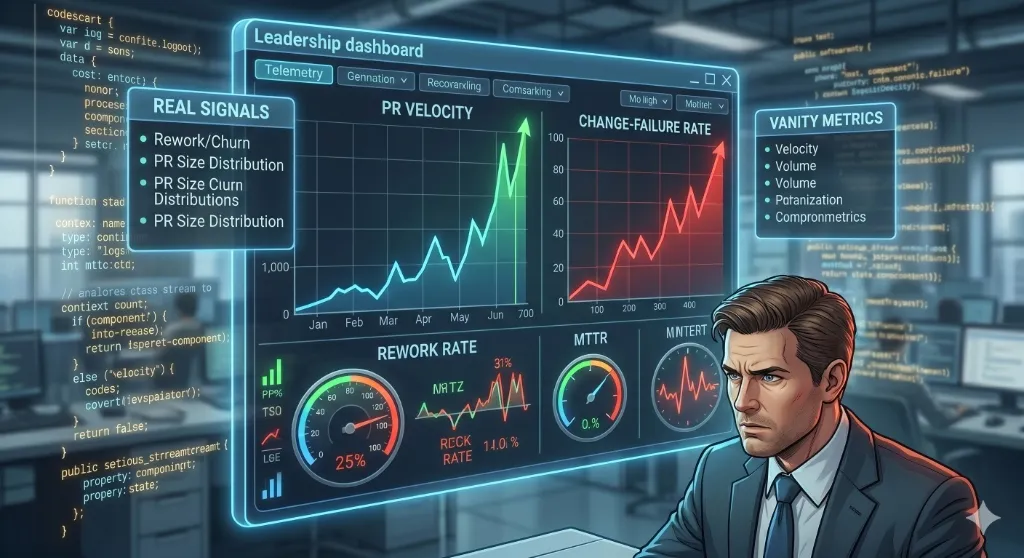
- PR-Size Distribution: Are your PRs staying under the 200-400 line threshold, or are engineers dumping massive AI-generated code blocks into the queue?
- Rework / Code Churn Rate: What percentage of code is being rewritten or discarded within 21 days of being merged? (High churn indicates "vibe coding" or poor context matching).
- Review Coverage & MTTR Reframed: Don't just look at how fast a bug is fixed; analyze the mean time to restore system stability alongside how thoroughly automated guardrails are intercepting failures before production.
The Leadership Challenge
Operating the pulley requires us to step off the factory floor. As engineering leaders, our value is no longer measured by how well we manage the flow of manual coding labor, but by how effectively we construct the scaffolding around automated execution.
If you are still running a legacy Agile playbook in an AI-accelerated world, you are throttling your team's potential. It’s time to rebuild the system of work.
How is your organization adjusting its SDLC to combat Acceleration Whiplash? Let’s discuss in the comments.