The Ship of Theseus and the Phantom Keel: Solving the Latent Collapse of Institutional Memory
Aug 25, 2026
In ancient Greek philosophy, there is a famous thought experiment known as the Ship of Theseus.
As Theseus’s wooden vessel aged over decades of voyages, each rotten plank was swapped out one by one. Eventually, not a single original sliver of timber remained. Philosophers asked: Is it still the same ship?
In naval architecture, however, the most critical part of a wooden ship is its keel—the central structural beam running along the very bottom of the hull. It is the spine that dictates how the ship cuts through water, absorbs heavy swells, and stays upright. Yet because it sits entirely underwater, nobody on the deck ever sees it while the vessel is sailing.
While philosophers debate the identity of the ship, software engineering leaders face a far harsher reality: what happens when a crew replaces every plank, forgets why the keel was carved in the first place, and sails straight into a storm?
The Phantom Keel in Production
In modern engineering orgs, systems undergo a continuous, silent replacement. Over three to four years, team turnover and re-orgs swap out nearly 100% of the original authors. The builds succeed, the pipelines stay green, and dashboards report nominal latencies. On paper, the vessel sails smoothly.
Then comes the 2:00 AM production spike.
A core message broker deadlocks. Digging through the module, the on-call engineer finds an arbitrary setting: batch_flush_interval_ms = 437.
Nobody knows why it is 437.
The author left two years ago. The Confluence page was never updated after the initial prototype, and the Slack thread is long gone. The crew knows how to deploy the service, but the original reasoning has vanished. It is a Phantom Keel, silently dictating system stability from beneath the surface.
This is the Latent Collapse of Institutional Memory. In calm waters, it looks like stability. But the moment you scale, refactor, or face an outage, you realize the platform has turned into a black box no one dares to touch.
The Three Phases of Memory Decay
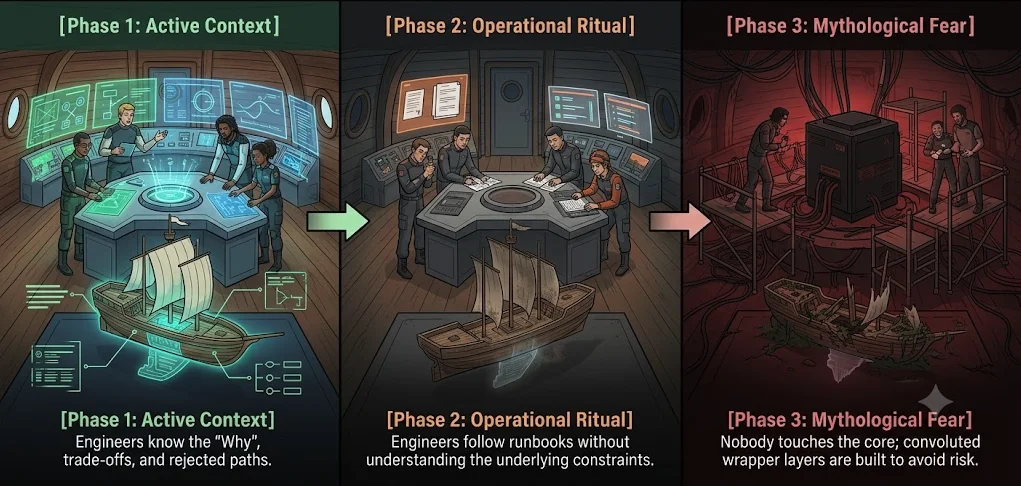
Institutional memory decays along a predictable curve:
- Phase 1: Active Context (0–12 Months): The original builders understand the trade-offs, the performance bottlenecks, and the alternatives that failed in testing.
- Phase 2: Operational Ritual (12–24 Months): The original team moves on. The incoming engineers learn what commands to run and which buttons to press. Understanding shifts from first-principles reasoning to mechanical execution.
- Phase 3: Mythological Fear (24+ Months): The component becomes untouchable. Teams build expensive proxy layers and awkward workarounds rather than refactoring the core, paying a permanent architectural tax to avoid confronting the unknown.
The Leadership Playbook: Engineering for Memory Durability
Mandating that "everyone must write more documentation" never works because static wikis rot the moment they are written. Memory durability must be codified directly into your day-to-day engineering mechanics.
1. Require In-Repo Architectural Decision Records (ADRs)
Never allow a non-obvious design boundary or magic number to exist without a short, markdown-based ADR committed directly alongside the code.
- The Golden Rule: Every ADR must explicitly state what was rejected and the condition under which this decision becomes invalid.
# ADR-014: Fixed Worker Pool for Payment Settlement

- Status: Accepted
- Date: 2026-04-10
- Context: Under high traffic spikes, our autoscaling container pool overloaded the legacy banking partner's SOAP gateway, triggering 504 gateway timeouts and account reconciliation mismatches.

## Decision

Cap concurrency at a fixed 20 background workers and enforce a hard 1,500ms socket timeout with circuit breaking.

## What We Rejected

- **Horizontal Pod Autoscaler (HPA):** Rejected because the downstream third-party banking API has a strict rate limit of 25 concurrent connections per client certificate. Autoscaling worsens the bottleneck.
- **In-memory queue buffer:** Rejected due to risk of losing in-flight settlements during node restarts.

## Invalidation Condition (When to change this)

This decision becomes invalid if the banking partner completes their migration to their async Webhook API (projected Q4), or if we introduce a distributed message queue (e.g., Kafka) with strict per-partition throttling.
2. Institutionalize "Tour of Duty" Rotations
Information gets trapped when a single person becomes the only gatekeeper of a system.
- Mandate a quarterly rotation where engineers spend a single sprint handling support or triage in an adjacent team's domain.
- If a critical system can only safely be touched by one specific individual, declare that service in a state of Critical Architectural Debt and immediately schedule knowledge-sharing pair sessions.
3. Run "Archaeology Sprints" & Recovery Fire Drills
You only truly own the software you can tear down and rebuild under pressure.
- The Drill: Take an unmaintained, low-churn service into an isolated sandbox, wipe its environment configuration, and assign an engineer who has never seen it before to spin it up from scratch within four hours using only repository documentation.
- Every blocker or missing detail encountered during the drill becomes an immediate P2 ticket on the sprint board.
4. Enforce an 18-Month Deprecation Review
Code that has not been deployed, tested, or modified in over 18 months is an unprotected risk to the business.
- Set an automated rule: if a service hasn't been touched in 18 months, flag the repo.
- The team must either upgrade its dependencies and prove it still safely builds, or plan its retirement.
None of these four practices require massive tooling overhauls or endless committee meetings. What they do require is the operational discipline to treat organizational memory as an active engineering concern rather than a passive byproduct of work.
When you codify the why alongside the how, you protect your platform from the quiet erosion of context.
Every production system is a Ship of Theseus in motion. The goal of engineering leadership is to make sure the structural physics of the system are never forgotten. Replace the planks as often as you need, but always make sure the next crew knows exactly how to navigate the keel.