Synchronous vs. Asynchronous Communication: The Tale of the Caller and the Sender
Nov 26, 2025

Synchronous vs. Asynchronous Communication: The Tale of the Caller and the Sender
November 26, 2025
Are you building systems that demand immediate attention like a ringing phone, or systems that efficiently process tasks in the background like a well-managed inbox?
In distributed systems and microservices, how services talk to each other defines your application's latency, throughput, and resilience. The two fundamental patterns, Synchronous and Asynchronous communication, shape the user experience and the system's ability to scale.
To make this architectural concept relatable, let’s visit a busy corporate office.
The Tale of Two Managers: Simon vs. Arthur
Simon the Synchronous Manager (The Phone Caller)
Simon believes in direct, immediate interaction. To get his report, he picks up the phone and calls Developer #1.
The Process:
He dials, waits on the line, talks for 5 minutes, and gets the data. Only after hanging up can he call Developer #2.
The Pro:
The feedback is instant. If there is a misunderstanding, he corrects it immediately. He knows exactly where he stands.
The Con (The Block):
On Tuesday, Developer #3 is in a meeting and doesn't answer. Simon sits on the phone, listening to the ringing, unable to move on to Developer #4. His entire morning is blocked because one person didn't pick up.
Arthur the Asynchronous Manager (The Emailer)
Arthur prefers decoupling and efficiency. To get his report, he drafts an email to all five developers.
The Process:
He hits "Send" on five emails instantly. He immediately closes his email client and goes to grab a coffee or work on another project. Throughout the day, the replies trickle in.
The Pro:
Arthur is highly efficient—he wasn't blocked. If Developer #3 is busy, Arthur is still productive elsewhere.
The Con (The Lag):
When a client calls Arthur asking, "What is the specific status of Developer #3?", Arthur doesn't know yet. He has to say, "I'll get back to you when they reply."
So, Which Approach is Better?
The truth is, neither approach is inherently "bad." Just like in an office, you need both:
- Simon’s approach (Synchronous) is critical when you need an answer right now (e.g., "Is the building on fire?").
- Arthur’s approach (Asynchronous) is superior for high-volume tasks where waiting is a waste of time (e.g., "Submit your timesheets").
The best architectures, like the best managers, know when to pick up the phone and when to send an email.
The Technical Bridge: Architectural Implications
When we translate this to software architecture, we aren't just choosing a coding style; we are choosing how our system handles failure and time.
1. Synchronous Communication (Request-Response)
In this pattern, the client sends a request and blocks execution until the server responds. It creates a direct dependency chain.
The Mental Model:
Tightly Coupled Chain. If Link A holds Link B, and Link B breaks, Link A falls.
What to Keep in Mind (The Watch-Outs):
- Cascading Failures: If Service B becomes slow, Service A waits. This waiting consumes resources (threads/memory) on Service A. If enough requests pile up, Service A crashes, potentially taking down the whole system.
- Latency Stacking: If an operation requires calling three services sequentially (A → B → C), the total latency is the sum of all three.
2. Asynchronous Communication (Event-Driven)
In this pattern, the sender emits a message to a broker (intermediary queue) and immediately moves on. The receiver processes it when it has capacity.
The Mental Model:
Decoupled Producers and Consumers. The Producer fills a bucket; the Consumer empties it at its own pace.
What to Keep in Mind (The Watch-Outs):
- Eventual Consistency: The data isn't up-to-date everywhere instantly. A user might change their profile photo, refresh the page, and still see the old photo for a few seconds.
- Dead Letter Queues (DLQ): What happens if a message is malformed and crashes the consumer? If you don't handle it, the consumer might try to process it forever (poison pill), blocking all other messages.
- Observability is Harder: In a sync call, if an error happens, you get a 500 Error immediately. In async, the error might happen 5 minutes later in a different service.
When to Use Which?
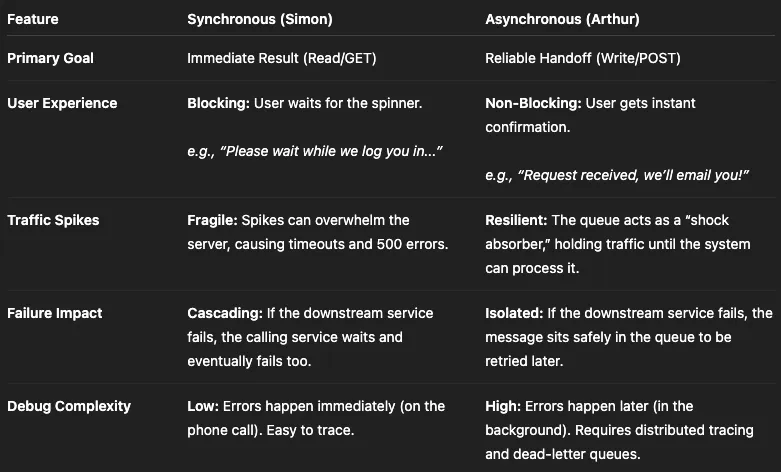
Great architects know that Synchronous communication is a dependency, while Asynchronous communication is a hand-off.
- Synchronous architecture is like Simon: Tightly coupled, immediate, but potentially fragile under load.
- Asynchronous architecture is like Arthur: Loosely coupled, resilient, but complex to track and debug.
Don't be a tourist in your own architecture.
Know when to pick up the phone, and when to send an email.
Your Turn: How Do You Architect?
In your current project, how do you decide whether to use Synchronous or Asynchronous communication?
Do you have a specific "tipping point" such as a strict latency limit (e.g., "anything over 500ms goes to a queue"), or do you decide based purely on the user experience?
Drop a comment below to share your decision framework. I’d love to hear your thoughts!
#SystemDesign #SoftwareArchitecture #Microservices #DistributedSystems #EngineeringLeadership